Let me paint you a picture.
You spend a solid afternoon pulling together a quote. You write up the scope of work, add your pricing, maybe drop in a few photos of previous jobs. It looks decent. You're happy with it. You attach it to an email, type something like "please find attached" — because apparently we all turned into 1980s office workers the moment we started sending PDFs — and you hit send.
Then you wait.
And wait.
Three days later, you follow up. They say they're still thinking about it. A week after that, you chase again. Nothing. The job goes to someone else, or maybe it just evaporates entirely, and you never find out which.
Sound familiar? It should — because this is happening to thousands of businesses every single day. The frustrating part is that the problem usually isn't your pricing or the quality of your work. It's the format you're delivering it in, and the complete lack of any system around it.
Here's what's actually going wrong, and more importantly, how to fix it.
The PDF Attachment Problem Nobody Talks About
When you attach a PDF to an email, something quietly terrible happens the moment you click send: you lose all control of it.
You don't know if it was opened. You don't know if they scrolled past page one. You don't know if your quote was forwarded to a partner, a spouse, a competitor — people who might actually be the real decision makers — without you ever knowing there are additional eyes on your work.
On top of that, opening a PDF on a phone — where most emails get read these days — is genuinely annoying. It downloads to a folder somewhere. You have to find it. It's slow. Half the time people just don't bother, and your beautifully crafted document sits unopened next to someone's old bank statements.
And here's the thing that really stings: even when someone does open it and read every word, you get absolutely nothing back. No data, no insight, no contact detail you didn't already have. You sent something valuable out into the world and received zero intelligence in return.
That's not a sales process. That's a lottery.
There's a Smarter Way to Share Your Documents
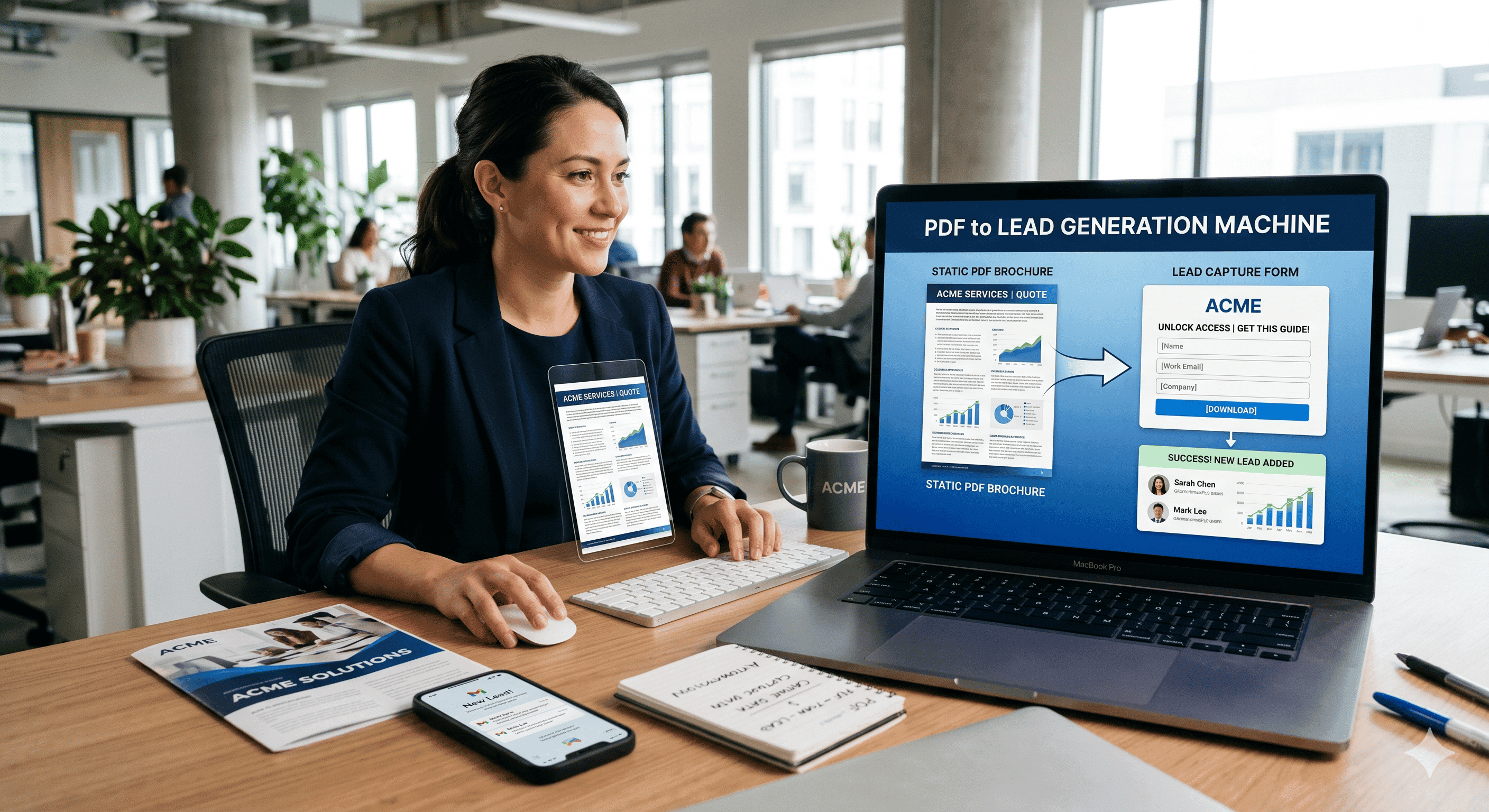
What if your quote or brochure could tell you the moment someone opened it? What if it could show you how far they read? What if — and this is the good bit — it could actually collect the contact details of everyone who viewed it, including people you never knew were looking?
This isn't wishful thinking. It's what happens when you stop sending PDFs as attachments and start sharing them as interactive digital flipbooks with a content gate built in.
The concept is simple: your document is converted into a page-turning online experience — the kind that actually looks and feels like flipping through a real brochure, not squinting at a static file. The first chunk is freely accessible. Then, at a natural pause point, a short form appears: name and email to continue reading.
Tools like ZipFlipBook make this genuinely easy to set up. You upload your PDF, choose where the gate kicks in, and get a shareable link. That's essentially it. Anyone who clicks the link — whether you sent it to them directly or they found it via your website or someone forwarded it — goes through the same process. They read, they engage, and if they want more, they hand over their email to get it.
Those emails go straight into a CRM dashboard. Every viewer logged. Every lead tracked. No spreadsheet wrangling, no manual follow-up reminders stuck to your monitor.
What This Actually Looks Like for Real Businesses
Let's get specific, because "interactive flipbook" can sound a bit abstract until you see how it plays out in practice.
Picture a builder who quotes on extensions and renovations. Instead of attaching a PDF, they send a link. The client clicks it on their phone, and a professional-looking interactive document opens immediately — no download, no fuss. They see the intro, the scope, some photos of similar projects. Good so far. Then they hit the pricing section, and a short form asks for their email to continue. They fill it in. The builder now knows exactly who's read the quote, how far they got, and has a confirmed email for follow-up. If the client forwarded the link to their partner — which happens constantly — the builder captures that second viewer too.
Or take a landscaping company with a services brochure full of before-and-after photos. As a static PDF, it's fine. As a flipbook, it's genuinely impressive — pages turn, images load cleanly on mobile, and the whole thing feels like a magazine. Halfway through, before the pricing page, the gate appears. Anyone who fills it in is a warm lead who has already fallen a little bit in love with the portfolio. That's a very different conversation to a cold enquiry.
A consultancy or agency can do the same thing with a useful free guide — something like "What Most Tradesmen Get Wrong About Google" or "A Homeowner's Guide to Planning Permission." Genuinely useful content, first half free, second half gated. The people who fill in the form to keep reading are self-selecting as exactly the kind of prospects worth following up.
But Here's the Thing — None of This Works Without Traffic
I want to be straight with you here, because a lot of marketing content glosses over this part.
A gated flipbook is a conversion tool. It turns interested visitors into leads. But it cannot conjure visitors from nowhere. If nobody's finding your link, nobody's filling in your form.
For most local businesses — tradesmen especially — the traffic problem is a local SEO problem. When someone in your area types "kitchen fitter in Macclesfield" or "roofer in Nantwich" into Google, your business either shows up or it doesn't. And if it doesn't, you're invisible to the majority of people who are actively looking to spend money on exactly what you offer.
This is where working with a proper SEO agency in Cheshire makes a real difference. Slingshot Marketing, based in Congleton, works specifically with tradesmen — builders, roofers, electricians, landscapers, plumbers, groundworkers — and their whole thing is getting those businesses found on Google by the right people in the right areas. They build websites that rank from the start, handle all the technical and content-side SEO, manage Google Business Profiles, and run ongoing campaigns that put you in front of local searches consistently. They're not a generalist agency trying to do everything for everyone — they know the trades, they know what local customers search for, and they know how to get you visible.
The combination of solid local SEO and a gated flipbook is genuinely powerful. SEO brings qualified local traffic to your website. Your flipbook converts that traffic into named, contactable leads. These two things aren't alternatives — they're two parts of the same system, and each one makes the other more valuable.
Setting It All Up: A Practical Walkthrough
Here's exactly how to put this together, step by step, without overcomplicating it.
Step 1: Pick the right PDF
Don't try to gate everything. Start with one document that represents real value to a potential customer — your most detailed services brochure, a portfolio of your best work, or a useful guide related to your trade. It should be something a prospective client would genuinely want to read before deciding whether to call you.
Step 2: Decide where the gate goes
A rough guide: let the first quarter to third of the document flow freely. This section should establish credibility, get the reader engaged, and leave them wanting more. The gate sits just before the most valuable bit — pricing, detailed project breakdowns, portfolio highlights. You want them invested before you ask for anything.
Step 3: Convert and configure
Upload your PDF to ZipFlipBook, set the gate position, and grab your shareable link. The whole setup genuinely takes under ten minutes. Test it on your phone first — that's how most people will view it.
Step 4: Replace your attachments
Update your email templates, your website's download buttons, your WhatsApp follow-ups — anywhere you currently send or host the document. Every PDF attachment becomes a live link. The experience for the recipient is actually better, and you're now capturing data instead of sending documents into the void.
Step 5: Sort your traffic
This is the part most businesses skip, and it's why their lead generation stays flat. Sharing your flipbook link on social media and to existing contacts is a start, but the real volume comes from being found organically by people who don't already know you. That's an SEO conversation, and if you're a trades business in Cheshire or the wider North West, it's worth having properly.
Step 6: Follow up like a human
Every email captured by your flipbook is a warm lead — someone who read your content and decided you were worth their contact details. Don't let that go cold. A short sequence of two or three follow-up emails over the next week, each one adding a bit of value or answering a common question, will convert a meaningful percentage of those leads into actual enquiries. Automated, warm, relevant. Worlds apart from a cold call.
The Mindset Shift That Makes All of This Click
There's a simple reframe that ties all of this together.
Stop thinking of your PDF as something you send. Start thinking of it as an asset you deploy.
A sent PDF is passive. It leaves your hands, stops working, and gives you nothing in return. A deployed flipbook is active. It works every time someone visits the link — whether you sent that link directly, it's embedded on your website, someone shared it on Facebook, or it appeared in a Google search. It qualifies reader interest automatically. It captures contact details without you having to ask awkwardly. It gives you the data to follow up with confidence rather than hoping in the dark.
The businesses winning more work right now aren't necessarily doing better work. A lot of them are just better at making their marketing run continuously — getting found through SEO, converting visitors through smart content, and following up on warm leads rather than chasing cold ones.
None of this requires a big budget or a marketing team. It requires the right tools, used in the right order, with a bit of consistency. The tools exist. The system is straightforward. And the difference between a business that's always scrambling for the next job and one with a steady pipeline of warm enquiries is often just this: one of them has built the system, and one of them hasn't.
Time to build the system.