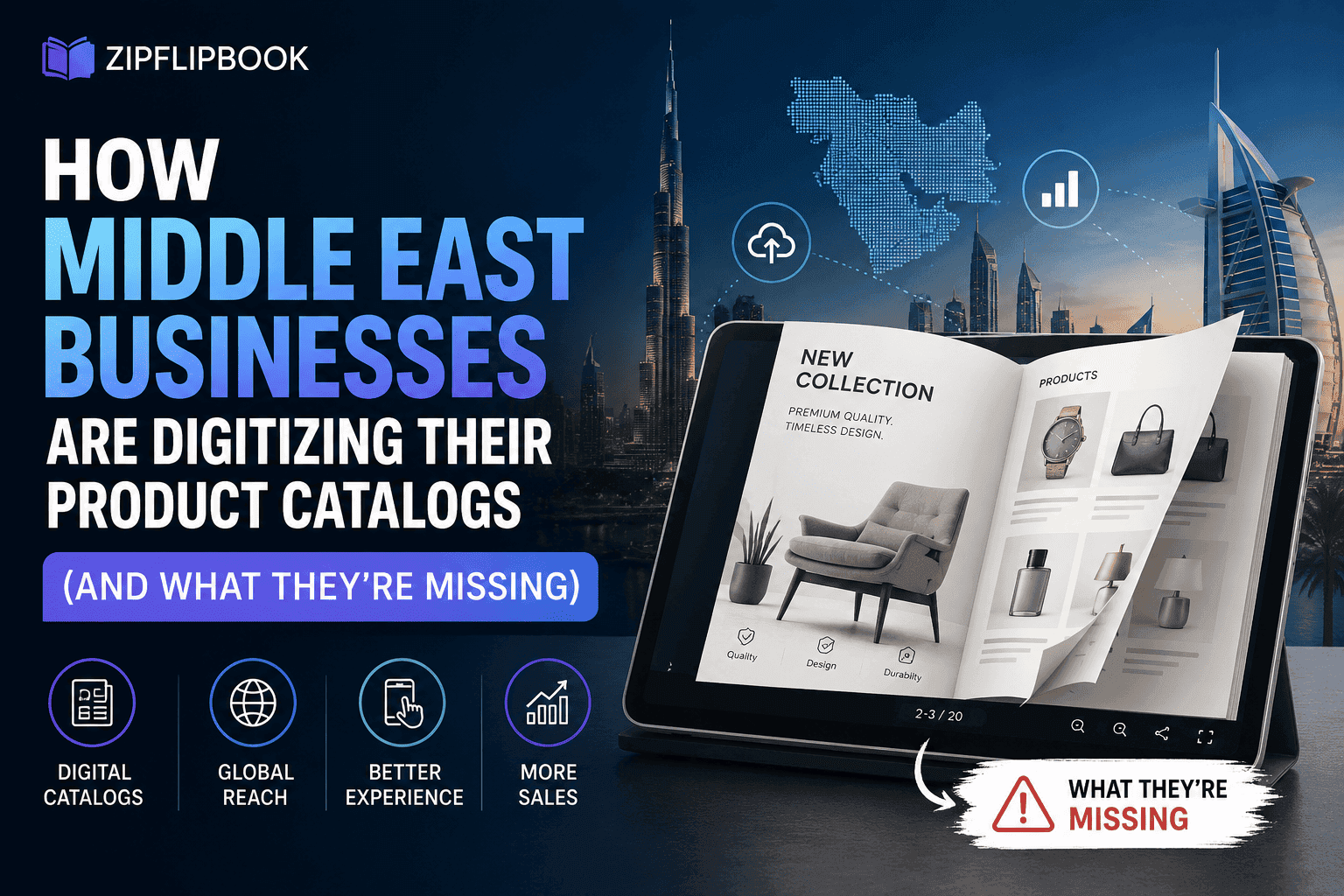
I realized this shift was real when a Dubai retailer told me he'd rather pay his graphic designer to reformat a PDF every week than pay the printing press again. That was two years ago. Now even the distributors in Muscat who swore by paper are begging for clickable links, and half of them still have a "digital catalog" that's just a PDF sitting on Google Drive nobody's opened twice.
Let's be brutally honest: swapping that PDF for a flipbook takes fifteen minutes. That's the bait. The eighty percent trap is everything happening after the upload button.
The catalog is not the hard part
Turning a PDF into something that flips, zooms, and tracks who's reading it takes maybe fifteen minutes with the right tool. I built ZipFlipbook because I got tired of watching small businesses pay agencies thousands of dollars for something that should take an afternoon. Upload the file, and you've got page-turn animations, embedded video, clickable links, lead capture forms baked into the pages themselves. That part is genuinely solved software at this point.
What's not solved — and what I keep seeing Omani distributors trip over — is the layer underneath the catalog. Your flipbook is pretty. Great. But where does the data in it actually live? If your pricing changes weekly because of currency fluctuation or supplier cost shifts, are you manually rebuilding a PDF every time, or is your catalog pulling from a system that already knows the current price? Most businesses I talk to are still doing the former, which means the "digital" catalog is really just a prettier version of the same manual process they had with print.
This is usually the point where the conversation turns to ERP, and it should. A catalog that's disconnected from your actual business systems is a marketing asset. A catalog that's connected to them is closer to a sales channel. Full disclosure: I build flipbooks, not ERPs. But I've watched Omani traders bleed money on stock discrepancies because their product data, stock levels, and pricing lived in three different spreadsheets instead of one system. If you're in that boat, get a local ERP firm on the line before you make your catalog pretty. Codestack does ERP solutions in Oman and deals with exactly this mess — because syncing prices with a spreadsheet by hand is a nightmare I can't fix for you from a flipbook editor.
Turn Your PDFs into Lead Generation Machines
Start getting highly-qualified leads from your PDFs and landing pages today. It takes exactly 2 minutes to set up.
No credit card required • Sign up in 10 seconds
Buying the tool isn't the grunt work
Don't buy the flipbook software and call it "digital housekeeping" done. That's like buying a steering wheel and calling yourself a racecar driver. Businesses in this region love to treat "going digital" as one purchase — get the flipbook tool, tick the box, move on — and that's not how any of this works, here or anywhere else.
If your warehouseman in Sohar is still updating stock via WhatsApp voice notes, your shiny new catalog is going to sell products you don't actually have, and that customer isn't coming back to find out why. A real catalog touches your point of sale, your inventory, your website, your customer data — and most small and mid-sized Gulf businesses don't have an in-house team that can wire all that together from scratch, nor should they try. Find the right implementation partner instead of piling on another SaaS subscription nobody integrates. Masirat's rundown of top IT companies in Oman is a decent starting point for seeing who's actually active in the market.
The tool is rarely the bottleneck. The bottleneck's almost always the integration work and the internal process changes nobody wants to touch.
What businesses actually get right when they do this well
The ones who pull this off well tend to do a few things differently, and it's rarely about picking fancier software. They start with the catalog as the front door, not the whole house. They accept that it needs to connect to something bigger eventually, and they plan for that instead of being surprised by it a year later. And they bring in people who've done ERP or IT integration in their specific market before, because Oman's business environment, banking rails, and vendor landscape aren't identical to what works in Europe or the US, and pretending otherwise wastes time and money.
The failures I see? They treat the flipbook like the finish line. Same manual price updates on Sunday nights. Same "out of stock" apology emails. Just with nicer animations.
Turn Your PDFs into Lead Generation Machines
Start getting highly-qualified leads from your PDFs and landing pages today. It takes exactly 2 minutes to set up.
No credit card required • Sign up in 10 seconds
Where I'd start if I were you
My actual advice? Digitize the front door first — it's the fastest visible win and it gets your team excited. But schedule the ERP conversation for the very next morning, not "eventually." Because a flipbook doesn't fix broken inventory. It just broadcasts it louder, in higher resolution, to more people.