Someone sends you a link. It's a two-minute brand film — sweeping drone shots, a celebrity voiceover, probably shot over three days in Iceland with a crew of forty and a huge budget. Beautiful. Really. And then comes the message: "We love this vibe. Can we do something like this?" Ugh.
It usually means the client arrived with a reference and a feeling (and high hopes), but no real B2B video content strategy behind what they're asking for.
This happens more than you'd think. A client finds something on YouTube that captures exactly the feeling they want, sends it over as a reference, and from that moment forward it lives in their head as the benchmark. Doesn't matter that it was produced for a brand with a marketing budget that has more zeros than their entire annual revenue. That's the thing they saw. That's the thing they want.
The production company's job, at that point, is to figure out what version of that feeling is actually achievable, and then make absolutely sure the client can see it — really see it — before anyone picks up a camera.
That second part is where most proposals fall short.
The Problem With How Most Proposals Get Delivered
A standard video production proposal is a PDF. Scope of work, deliverables, timeline, price. Maybe some bullet points about your process. It's functional. It covers what needs to be covered legally and logistically. What it doesn't do is show a client what they're actually going to see on the screen.
And clients, through no fault of their own, are generally not great at visualizing. That's not an insult. It's just true. They're experts in their business, not in cinematography. When they read "warm, natural lighting with a documentary feel," they might picture something completely different from what you're planning to shoot. Both of you leave the proposal stage feeling aligned. You're not — and you need to fix this in pre-production.
That gap is where shoot-day surprises come from. It's where "this isn't quite what I had in mind" comes from, two days after you've wrapped. It's expensive for everyone and leads to disappointed clients, even though you did nothing wrong.
What a Proposal Should Actually Do
A proposal isn't just a contract setup. It's a communication tool. Its job is to get everyone looking at the same picture before production starts, because fixing a misunderstanding in pre-production costs nothing. Fixing it in post costs a lot. Fixing it after delivery sometimes means losing a client.
The more visual you can make that communication, the less room there is for the gap to form.
This is why the pre-production document stack matters — and why the format you deliver it in matters more than most people think.
The Pre-Production Stack
A solid pre-production package for a video project usually involves a few different pieces, and each one does a specific job.
The proposal sets the scope. What's being produced, what's included, what isn't, timeline, price. This is the document that protects both sides.
The look book is where you start closing the visualization gap. This can include reference images, color palettes, lighting examples, and locations with a similar feel to what you're planning. Not "here's what we'll shoot," but more like "here's the world this video lives in." A client who can see the visual language you're going for has a much better shot at knowing whether it matches what they had in mind.
The storyboard takes it further. Panel by panel, rough or detailed depending on the project, showing the actual sequence of shots. A client who has never been on a set can look at a storyboard and understand, in a way that a script never quite achieves, what the finished piece is going to feel like.
Shot lists are more for the crew than the client, but sharing them builds confidence. It shows you've actually planned the day. Clients who've been burned by disorganized productions before tend to respond well to seeing that someone's thought through every setup.
And for bigger pitches, a pitch deck pulls it all together into a narrative — the creative concept, the strategy behind it, the expected outcome — in a format that's easy to walk through on a call or share with a decision-maker who wasn't in the room.
All of this exists to do one thing: make sure that when the camera starts rolling or the edited first cut gets delivered, nobody is surprised.
Why a Flipbook Changes How This Lands
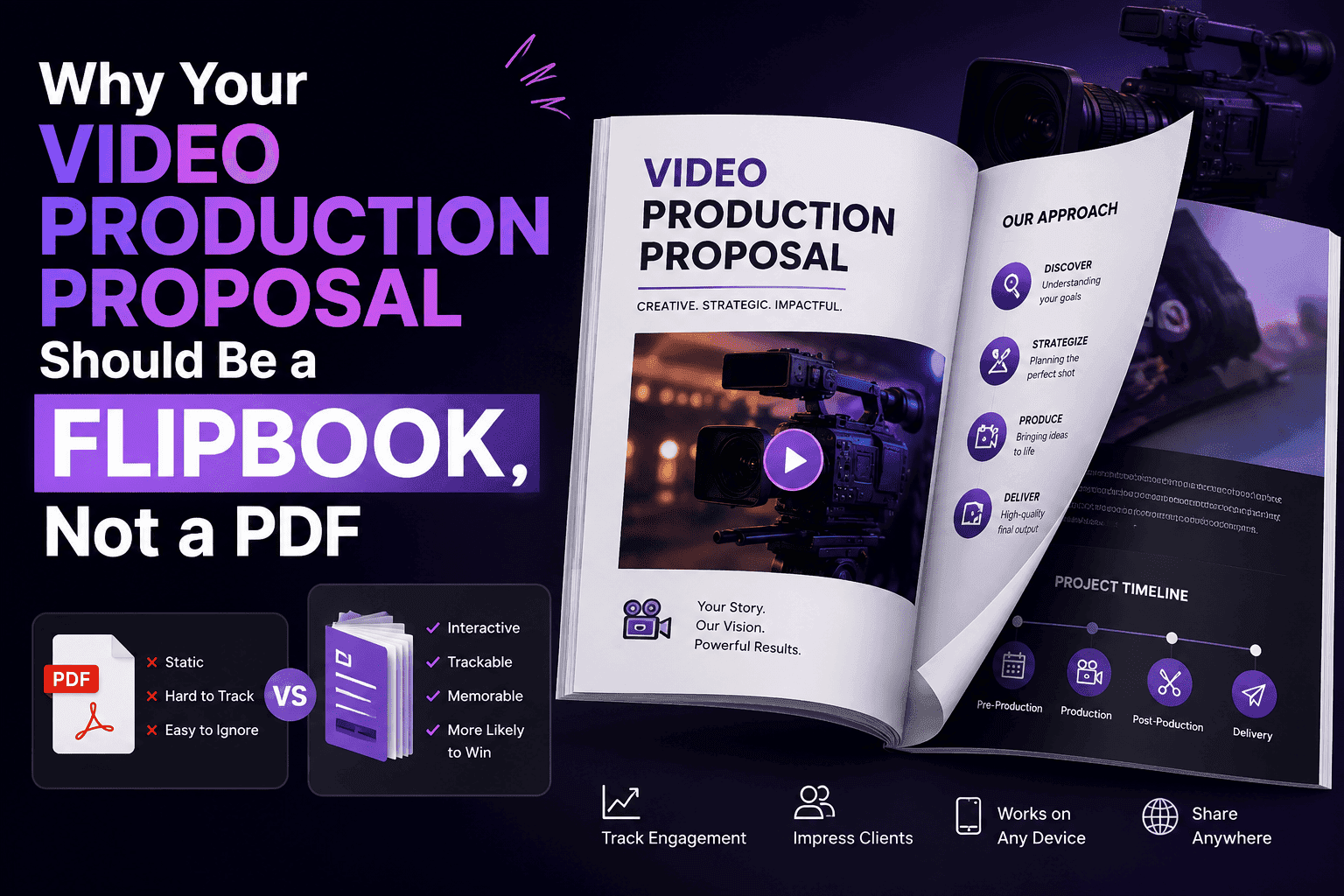
Here's the issue with delivering all of that as a PDF. A PDF is static. It's flat. You can embed a link, but it opens somewhere else, pulls the client out of the document, and half the time they don't bother clicking it. Reference images sit there small and unengaging. The whole thing reads more like a legal document than a creative presentation.
A flipbook format changes the experience without changing the work. The same content — the proposal, the look book, the storyboards — lives in something that actually pages through like a magazine, can have video references embedded directly in context, and works on any device without the client having to download anything or zoom around a huge fixed-layout page on their phone.
More importantly, it feels like the project is already underway. A client who opens a well-built interactive proposal feels like they're being walked through something, not handed paperwork. That feeling matters. It sets the tone for the whole production relationship.
Tools like ZipFlipbook make this easier than it used to be. You build the document the way you normally would, convert it, and what comes out the other side is something that embeds cleanly on a page or shares as a link. The production workflow doesn't change. The client experience does.
The Real Payoff
Nobody ever complained that a proposal was too clear. Every hour spent making sure a client genuinely understands what they're getting is an hour that pays for itself somewhere in post-production, or in the conversation that doesn't happen after delivery.
The clients who feel most confident going into a shoot are the ones who come back. And the ones who come back are the ones who felt like they knew what they were getting, saw it laid out in front of them, and got exactly that.
A flipbook doesn't replace the creative work. It just makes sure the client can actually see it before shoot day.