A client of mine runs a three-person letting agency and needed a property brochure turned into something she could text to a viewer on the drive over. Not a design project. Not a rebrand. Just a PDF that needed to stop looking like a PDF. That's most small businesses' actual relationship with digital brochure software — not "which platform has the most templates," but "which one won't cost me an afternoon and a bill I'll forget about by month three."
So here's what I've found testing most of the free digital brochure tools on the market, from the perspective of someone who doesn't have a design department or a marketing budget to throw at this.
What actually matters when you're small
Big companies choosing publishing software care about seat licenses and brand governance. You don't. You care about three things: how fast you can go from PDF to shareable link, whether the free plan is actually usable or just a demo, and whether your brochure looks like it came from a real business or a free trial. Everything else — templates, page-flip sound effects, digital bookshelves — honestly, that stuff doesn't matter until the basics are sorted.
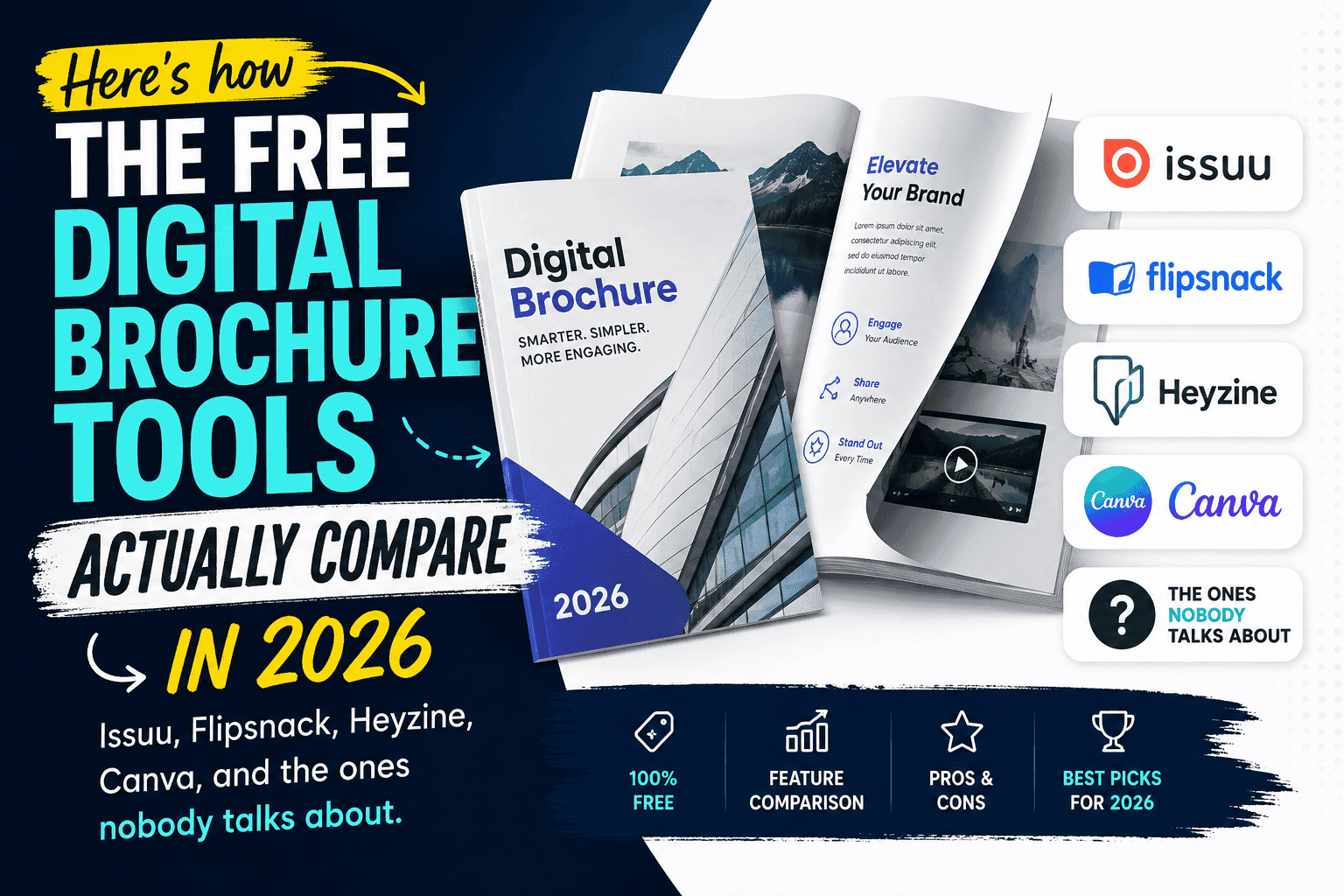
Issuu
Issuu is the one everyone's heard of, which is both its strength and the reason it disappoints people. The free plan gives you five published documents, capped at ten pages each, with Issuu's own branding sitting on top of your content. Publish a sixth document and your oldest one stops being readable — visitors get the cover and a message telling them access is limited, which is not the kind of thing you want to discover after you've already texted the link to a client.
There's no lead capture on the free tier and barely any analytics worth checking. If you want the features that make a brochure worth publishing online in the first place, you're looking at somewhere north of $19 a month, climbing fast once you need real reader data.
Flipsnack
Flipsnack is more capable as a design tool — it has a genuine drag-and-drop editor, so if you're building something from scratch rather than converting a finished PDF, it holds up better than most of the free options here. The catch is the free plan caps you at three publications, thirty pages each, watermarked, and in some cases you can't even export your own finished file without upgrading. I've seen small business owners spend an evening designing something in Flipsnack only to hit a paywall trying to download it.
Paid plans start around $30 a month for the tier where lead forms and analytics actually switch on. Fine if you're publishing weekly. Overkill if you needed one brochure done by Friday.
Heyzine
Heyzine is worth knowing about because it's aimed more squarely at solo operators and developers than the bigger names. The free tier gives you a handful of digital brochures and API access even on the free plan, which is unusual. Where it gets confusing: the free tier limits seem to change depending on when you check their website. Reader analytics and a custom domain are locked behind paid tiers starting around $4 a month, climbing to $14 for anything with real reader insight. I'm still not totally sure Heyzine is worth the setup time if you just want one thing out the door fast — but if you're comfortable with a slightly techier interface, it's fine.
Canva
Worth mentioning because everyone already has an account and assumes it does everything. It doesn't, not this. Canva is genuinely excellent for designing a brochure from a blank page — better than any dedicated brochure tool, honestly. But it was never built to turn that design into an interactive, trackable, page-turning publication. You get a PDF export or a static shareable link, not real reader analytics, not lead capture, not a page-flip experience that makes someone actually want to click through. Design it in Canva if you're starting from nothing, then take the finished PDF somewhere built for the second half of the job.
How long it actually takes to get a link you can send
Nobody selling digital brochure software puts "time to first published link" on their pricing page, but it's the number that matters most if you've got a viewing in forty minutes and no brochure ready. Issuu and Flipsnack both want you through an account setup, a plan selection screen, and in Flipsnack's case sometimes a template choice before you've even uploaded anything. Heyzine is quicker, closer to a straight upload-and-go, though the interface assumes a bit more comfort with settings and toggles than someone doing this once a month will want. Canva isn't really in this race at all — it's a design session, not a five-minute task, and that's fine when design is the point but frustrating when it isn't.
The "forty minutes before a viewing" thing is exactly what I had in mind when I built ZipFlipbook. Upload the PDF, get a link, done. No account wall, no guesswork — just a working link you can actually send someone.
Turn Your PDFs into Lead Generation Machines
Start getting highly-qualified leads from your PDFs and landing pages today. It takes exactly 2 minutes to set up.
No credit card required • Sign up in 10 seconds
The bit where the free plan quietly stops being free
Every tool here has a moment where "free" stops being free, and for a small business that moment always seems to hit at the worst possible time — mid-season, mid-campaign, right when you've finally built a habit of publishing regularly. You hit the document cap, or a client asks why there's someone else's logo on your brochure, or you realize the one feature you actually need — knowing if anyone read past page one — was never on the free tier to begin with. That's not a coincidence. Free tiers on most of these platforms are built to get you comfortable, then charge you once switching feels like more hassle than paying.
For a business with one or two people and no dedicated marketing spend, that upgrade pressure is worse than it sounds. Twenty or thirty pounds a month doesn't register on a company budget with a marketing team behind it. For a sole trader, it's a real line item, and it's usually for features — analytics, lead capture, a clean unbranded link — that shouldn't have been premium in the first place.
The tool I built after giving up on all of these
I ended up building ZipFlipbook because I kept hitting the same wall with every option above — free plans that weren't worth the setup time, or paid plans that cost more than the brochure itself was worth to the people using it. A letting agent sending one property brochure a week doesn't need to pay Flipsnack prices to avoid looking like they're using free software.
It's browser-based. Upload a PDF, get an interactive flipbook back with proper page-turn animation, no watermark stamped across it apologizing for the fact you didn't pay. Lead capture's just there — no paywall. Same with analytics. You can actually see if anyone's getting past page two, which tells you more than any template library ever will. No account gymnastics, no design editor to wade through if all you want is a finished PDF turned into something people will actually open.
I'm not pretending to be neutral about this one. I built it specifically because small businesses kept getting priced out of features that should be standard, not premium.
Turn Your PDFs into Lead Generation Machines
Start getting highly-qualified leads from your PDFs and landing pages today. It takes exactly 2 minutes to set up.
No credit card required • Sign up in 10 seconds
What I'd actually tell a small business owner
If you're designing from scratch, start in Canva, then convert the finished PDF somewhere purpose-built. If you've already got a brochure or menu or catalogue sitting as a dead PDF attachment, skip anything that gates analytics and lead capture behind a monthly plan — that defeats the entire point of putting it online. And if you're publishing regularly, watch the document caps closely. Three or five sounds generous until you're four months in, updating seasonal offers, and suddenly locked out of your own back catalogue.
Most "free" digital brochure software in 2026 is free like a gym trial — good for looking around, not much use for actually working out. If you want something that stays free, doesn't put someone else's branding on your work, and gives you the basics a small business actually needs to know whether the brochure is doing its job, that's the gap I built ZipFlipbook to close.