I used to budget for brochures the way I budget for petrol—annoying, but you just pay it because that's how it works. Then I actually tracked what one print run cost me. The number made me wince. Not because any single brochure was expensive, but because of how often I had to bin the whole batch the week a property sold, forty unused copies sitting in a cupboard.
If you're an agent, developer, or anyone selling property on either side of the Atlantic, you've felt this too. Most articles give you a vague number or skip straight to flogging you a printer. So here's the actual maths—and what I did next.
The American number
In the US, a basic single-sheet property flyer is cheap on paper. Printers will happily quote you $0.15 to $0.35 a copy if you order a thousand at once, glossy, full colour, no fold. That sounds great until you remember a single property listing doesn't need a thousand copies. It needs maybe thirty, for one open house, for one street. At that volume you're paying closer to $0.75 to $1.10 each, and once you fold it into a proper tri-fold or bi-fold the price climbs again, sometimes to $1 to $2.50 a piece for a decent stock with images that don't look washed out.
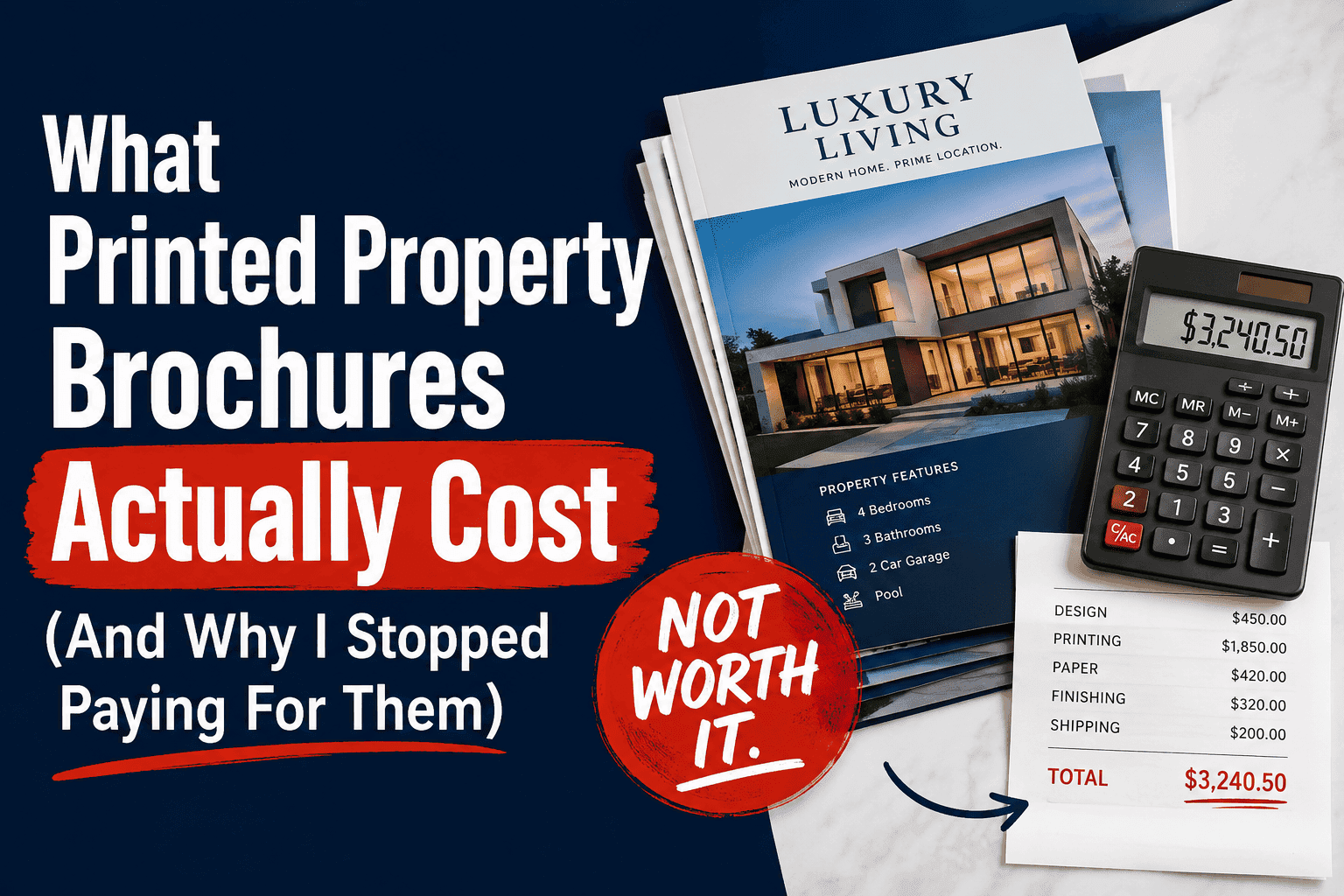
That's the cheap end. The moment a listing is high value, you're not handing out a single flyer, you're producing a multi-page booklet: cover stock, eight to twenty-four pages inside, a proper layout. That kind of print run behaves more like a small catalogue than a flyer, and catalogue pricing in the US sits anywhere from $2.50 to $15 a copy depending on paper weight and finish. Add a designer if you're not doing it yourself, $75 to $125 an hour, with a twelve-page brochure eating six to twelve hours of someone's time. That's $900 to $3,000 before a single copy has come off the press.
Then there's the bit nobody puts in the calculator: turnaround. Standard print jobs run five to seven business days. Need it faster because a viewing got booked for Saturday and it's already Thursday? Rush printing adds twenty five to fifty percent on top. I've watched agents pay double just because the listing photos came back from the photographer two days later than planned.
And quantity cuts the wrong way for property. Print shops reward bulk orders, but property brochures aren't bulk goods. A house sells, a flat gets let, a development phase closes out, and every leftover copy of that brochure is now landfill. Print 500 because the unit price looked better on the calculator, sell the house in three weeks, and you've just paid for 470 pieces of paper that did nothing but sit in a box.
Run the numbers on one fairly ordinary listing and it adds up faster than you'd think. Say it's a $450,000 family home. You commission a designer for a six-page brochure, four hours at $100 an hour, $400. You order 40 copies on a decent gloss stock for the first open house, call it $1 each once you account for the short run, $40. Two weeks later the price drops $10,000 and every brochure in the office now shows the wrong number, so you reprint another 30, another $30 plus a same-day rush fee because the next viewing is tomorrow, easily another $40 on top. You're past $500 on a single listing before you've spent a cent on photography, signage, or the listing portal fees that were already eating into the agent's margin. Multiply that by however many active listings an agency is juggling at once and the printer bill quietly becomes one of the bigger line items nobody questions.
What Property Brochures costs in the UK and across Europe
The picture in the UK runs along similar lines, just dressed differently. Estate agents lean heavily on digital, short-run presses for exactly this reason: listings turn over fast, and the old approach of a big litho print run makes no sense when a property might be sold or withdrawn within a fortnight. So agents print in small batches, on demand, which avoids the warehouse-full-of-unsold-brochures problem but pushes the per-unit price up because you lose the bulk discount.
A typical A4 property brochure here uses paper stock somewhere in the 170 to 300 gsm range, heavier for the cover, lighter for the inner pages if it's posted out rather than handed over in person. Go for a gloss or silk finish, which most agents do because matte paper makes a million pound house look like a council newsletter, and you're paying a premium over the basic stock. Add lamination, spot UV, or foiling on a luxury listing brochure, which higher end agencies often do to signal the price bracket, and the cost per copy for a short run lands well above what the cheap online printers advertise on their homepage.
I can't give you one tidy number—an A4 flyer for a two-bed terrace and an eight-page booklet for a country house aren't the same product, or the same price. But the pattern holds across both sides of the Atlantic: the nicer the property, the more it costs to print something that does it justice, and the faster that listing turns over, the worse the economics of printing it in any quantity that makes financial sense.
Cross the Channel and the same logic applies with local variations. French and German agencies often favour heavier, more formal booklets for higher value listings, which pushes paper and finishing costs up further, while Spanish and Italian agents marketing to international buyers frequently print the same brochure in two or three languages, multiplying the print run for a single property rather than producing one version. Multilingual print runs in particular are brutal for cost, because you can't reuse the same stock across markets, and a brochure that goes stale the moment a price changes now goes stale three times over.
None of this counts design time, none of it counts a reprint when the price drops by ten grand and every brochure in the office now has the wrong figure on the front page, and none of it counts postage if you're mailing brochures to a list rather than handing them out. Add those up across a year and a busy agency or developer is comfortably spending thousands of pounds, or thousands of dollars, on paper that has a shelf life measured in weeks.
What I did instead
I run ZipFlipbook, and the honest version is I got sick of the maths above. I had a PDF brochure, a property that sold faster than the print order arrived, and a stack of glossy paper that cost real money and did nothing. So I built a tool that takes the PDF you already have, the one your designer already made, and turns it into an interactive flipbook you can embed on your website or send as a link. No print run, no minimum order, no leftover stock.
The free tier on ZipFlipbook lets you upload a PDF and turn it into a flipbook anyone can view, page through, and zoom into on their phone, without you paying a printer a penny. That alone solves the biggest waste in the whole process: the brochures that get printed for one viewing and then binned. With a digital flipbook, the listing exists for as long as the property is on the market, and the moment it's sold or the price changes, you update the PDF and the flipbook updates with it. No reprint, no wasted stock, no awkward conversation about who's paying for the redo.
It also does things a printed brochure simply can't. You get analytics on who's actually opening it and how long they spend on which page, which tells you more about buyer interest than handing someone a glossy booklet ever will. You can capture leads directly inside the flipbook, so a viewer who wants the full floorplan has to leave their email first. You can drop in a video walkthrough or a 360 tour link right inside the pages instead of QR-coding your way around the limits of paper. None of that exists in print, and all of it works on the free plan.
If you want to go further, there's a paid tier for agencies running this at scale, with white-label branding so the flipbook lives under your domain rather than ours, and more detailed lead and engagement reporting. But the core conversion, the thing that actually replaces the printer, costs nothing. You're not trading a cheap print run for an expensive subscription. You're removing the print run entirely.
Turn Your PDFs into Lead Generation Machines
Start getting highly-qualified leads from your PDFs and landing pages today. It takes exactly 2 minutes to set up.
No credit card required • Sign up in 10 seconds
I'm not going to pretend printed brochures are dead. There are still viewings where someone wants to walk away with something physical, and a beautifully bound booklet still has a place at the very top end of the market, where the printed object is part of the experience you're selling alongside the house. But for the day to day reality of selling property, where listings come and go in weeks and every printed copy is a small bet that the house won't sell before the order arrives, a free digital flipbook just makes more sense. It costs nothing to produce, nothing to update, and nothing to bin when the property finally sells.
If you've got a property PDF on your desktop, drop it into the free tool—it takes two minutes. No card, no quote, and no waiting a week to see if it works.